How Sleep Shapes Mood Across the Menstrual Cycle
This study examines how nightly sleep physiology predicts next-day mood across different phases of the menstrual cycle in naturally cycling women. Using repeated in-laboratory polysomnography (PSG), daily mood tracking, and a within-subject phase-confirmed design, we identified phase-specific relationships between sleep architecture and emotional outcomes. Greater REM sleep and slow-wave sleep (SWS) were associated with improvements in positive mood, while longer total sleep time and reduced wake after sleep onset (WASO) were linked to reductions in negative mood and anger. Importantly, these relationships varied across menstrual phases, demonstrating that the emotional benefits of sleep are not uniform across the cycle. The findings highlight menstrual cycle phase as a critical biological context for understanding how sleep supports emotional well-being in women.

REM Sleep Buffers Mood During Menstruation
This project investigates how menstrual cycle neuroendocrine dynamics shape the relationship between sleep and overnight mood change. In a longitudinal sample of naturally cycling women, we tested whether sleep stages interact with hormonal phase to predict next-day mood outcomes. Results revealed that REM sleep plays a particularly important role during menses, where greater REM duration was associated with improved overnight positive mood. These findings suggest that REM sleep may function as a protective mood-regulation mechanism during hormonally sensitive windows of the cycle. The work provides evidence that menstrual phase modulates sleep–emotion coupling and underscores the importance of incorporating female-specific biological rhythms into sleep and mental health research.

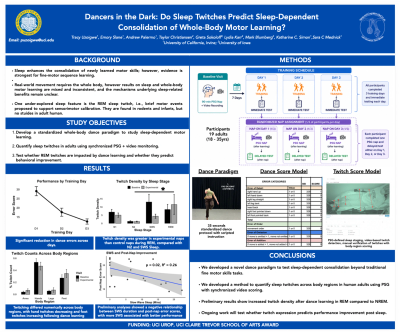
REM Sleep and Whole-Body Motor Learning
This study investigates whether REM sleep twitches contribute to the consolidation of complex, whole-body motor learning in healthy adults. We developed a novel standardized dance-learning paradigm combining repeated motor training with polysomnography (PSG), synchronized full-body video, and detailed behavioral performance scoring. Participants completed a baseline nap followed one week later by three days of dance training, with a post-learning nap assigned to one training day. Participants showed robust improvement in dance performance across training, while synchronized PSG-video recordings demonstrated that sleep twitches can be reliably identified and quantified across body regions in adults. Preliminary findings showed greater twitch density following dance learning during REM sleep relative to NREM sleep, with numerical increases in hand and foot twitching. Slow-wave sleep was also associated with greater post-nap improvement in dance performance. This work establishes a new framework for studying sleep-dependent motor memory beyond traditional fine-motor tasks and provides the foundation for determining whether REM twitching reflects the refinement of newly acquired whole-body motor skills.